“A fault code is a clue—not a diagnosis.”
If there’s one lesson I’ve learned after decades working around heavy-duty trucks and diesel engines, it’s this:
Great technicians don’t replace parts. They solve problems.
One of the biggest misconceptions among newer technicians is believing that a fault code identifies the failed component. It doesn’t.
A fault code simply tells you that one of the truck’s electronic control modules has detected something operating outside of its expected parameters. That information is extremely valuable—but it’s only the beginning of the diagnostic process.
Understanding the difference between a fault code and a diagnosis is one of the most important skills a diesel technician can develop.
The Evolution of Heavy-Duty Truck Diagnostics
Today’s trucks are incredibly sophisticated compared to the trucks many veteran mechanics started their careers working on.
Years ago, diagnosing an engine often meant relying on experience, observation, and mechanical testing. There were no electronic fault codes to guide you. If a truck had a problem, you listened to it, inspected it, and worked through the system until you found the cause of the failure.
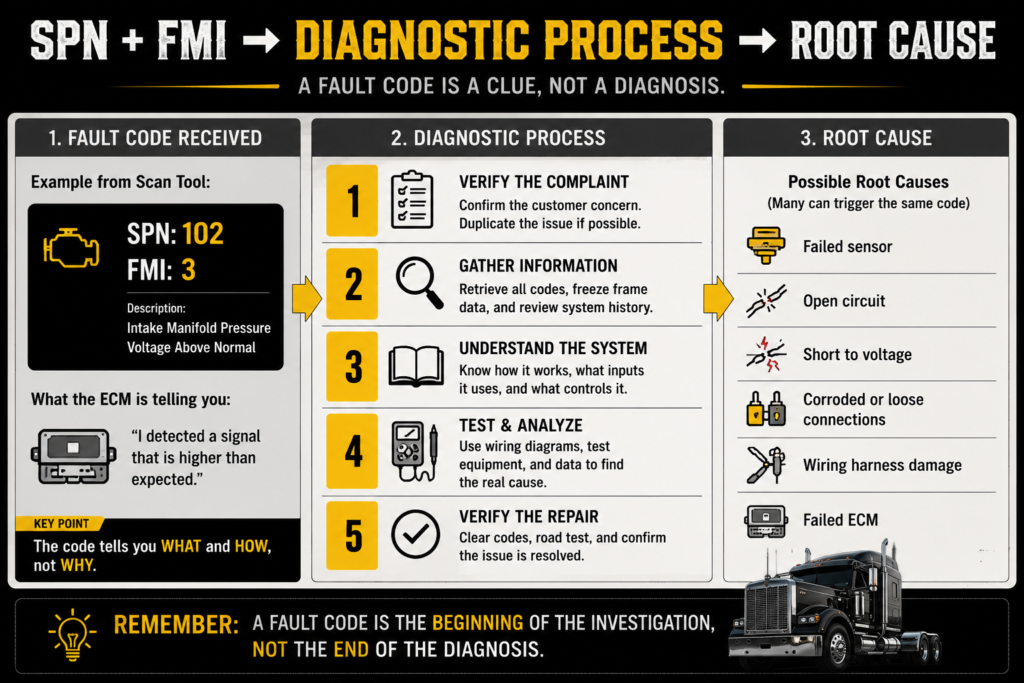
As electronics became more common, the trucking industry adopted SAE J1708/J1587, allowing electronic control modules to communicate basic diagnostic information.
For many technicians, this was their first experience working with electronic fault codes.
While you’ll still encounter J1708/J1587 systems on some older trucks, nearly every modern Class 8 truck now communicates using SAE J1939, a Controller Area Network (CAN) communication system that allows dozens of electronic modules to exchange information thousands of times every second.
Instead of simply monitoring the engine, today’s trucks monitor nearly every major system:
- Engine
- Transmission
- ABS
- Instrument Cluster
- Body Controller
- HVAC
- Aftertreatment
- Steering
- Suspension
- Collision Avoidance Systems
- Camera Systems
- Tire Pressure Monitoring
This increased complexity makes diagnostics more important than ever.
What Is a Fault Code?
A fault code is nothing more than an electronic controller saying:
“I detected something outside of my expected operating range.”
That’s all.
It is not saying:
“Replace this sensor.”
Let’s look at an example.
Imagine your scan tool reports:
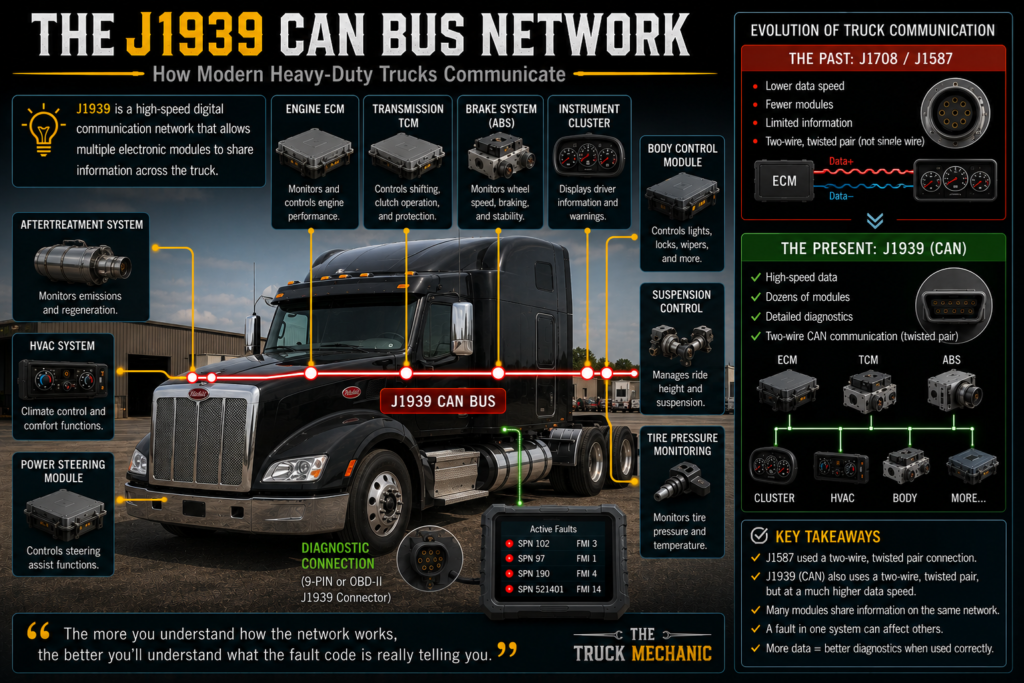
SPN 102 FMI 3
Many inexperienced technicians immediately assume:
“The intake manifold pressure sensor is bad.”
Maybe.
Maybe not.
The controller isn’t telling you the sensor failed.
It’s telling you it received a higher-than-expected voltage.
That abnormal voltage could be caused by:
- Failed sensor
- Open circuit
- Short to voltage
- Damaged connector
- Corroded terminals
- Wiring harness damage
- Failed ECM
- Improper previous repairs
Every one of those conditions can produce the same fault code.
Replacing the sensor without testing may fix the problem…
Or it may accomplish absolutely nothing.
Understanding SPN and FMI
Modern heavy-duty trucks using J1939 diagnostics report two pieces of information that technicians use together.
SPN (Suspect Parameter Number)
The SPN identifies what system or parameter the controller is concerned about.
Think of the SPN as identifying the area that deserves your attention.
Examples include:
- Intake manifold pressure
- Coolant temperature
- Oil pressure
- Accelerator pedal position
- Fuel pressure
- Turbocharger speed
The SPN tells you what the controller is monitoring.
FMI (Failure Mode Identifier)
The FMI describes how that parameter is behaving abnormally.
Examples include:
- Voltage High
- Voltage Low
- Data Erratic
- Out of Calibration
- Mechanical System Not Responding
- Data Valid but Above Normal
- Data Valid but Below Normal
Now we’re getting somewhere.
The controller isn’t saying:
“This sensor failed.”
It’s saying:
“The signal doesn’t look right.”
Those are two very different statements.
Why Fault Codes Don’t Identify Failed Parts
Let’s use a simple analogy.
Imagine your smoke detector goes off.
Did the smoke detector fail?
Probably not.
It’s simply reporting that it detected smoke.
Now you need to determine why.
The same thing happens on trucks.
The ECM reports:
“I received a signal that doesn’t make sense.”
Now it’s your job as the technician to determine why.
Experienced technicians understand this immediately.
Less experienced technicians often replace whatever component is mentioned in the fault description.
That’s where unnecessary parts replacement begins.
The Diagnostic Process
One of the biggest differences between an average technician and an exceptional technician is having a consistent diagnostic process.
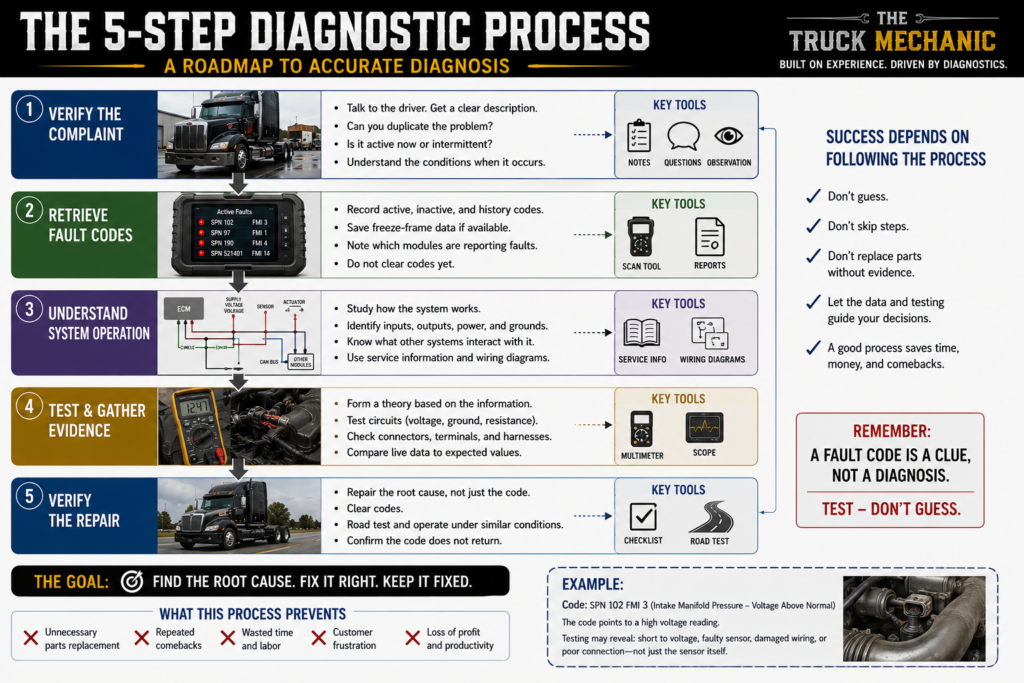
Mine has always been fairly simple.
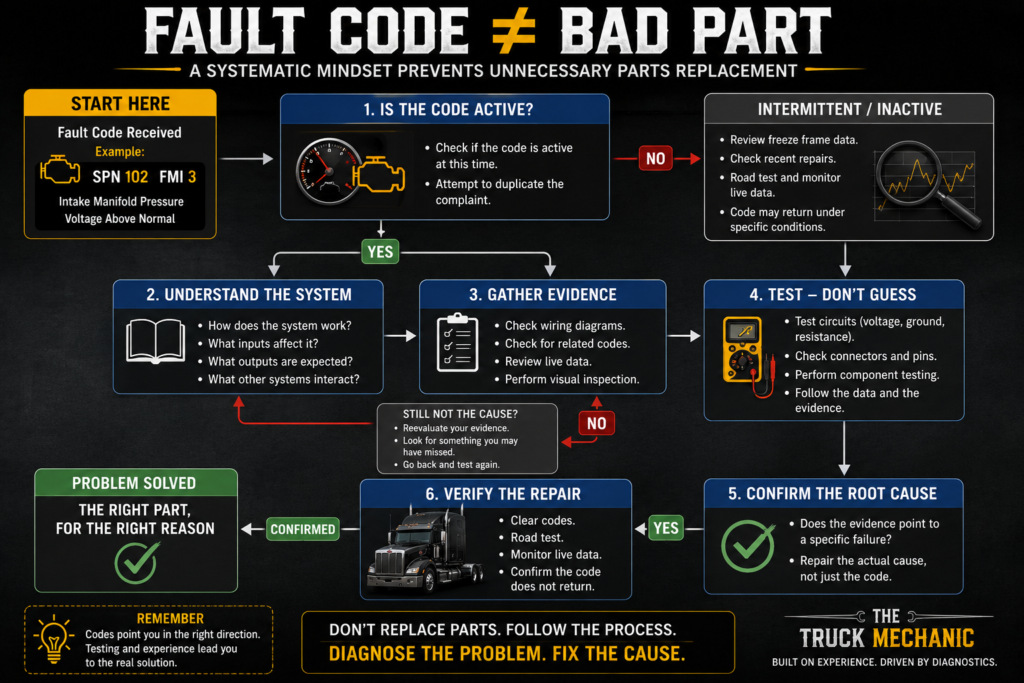
Step 1: Verify the Complaint
Never assume the customer’s description tells the whole story.
Can you duplicate the problem?
Is it intermittent?
Is it active right now?
The first step is understanding exactly what you’re trying to fix.
Step 2: Retrieve Fault Codes
Record:
- Active faults
- Inactive faults
- History codes
- Freeze-frame data (if available)
Never erase codes before documenting them.
Once they’re gone, valuable information disappears with them.
Step 3: Understand System Operation
This step gets skipped far too often.
Ask yourself:
How is this system supposed to work?
What sensors provide information?
What components are involved?
What powers the circuit?
Where are the grounds?
What other modules communicate with it?
Without understanding the system’s operation, diagnostics becomes guesswork.
Step 4: Test
Now begin proving your theory.
Use:
- Wiring diagrams
- Multimeter
- Voltage drop testing
- Oscilloscope (when necessary)
- Scan tool data
- Service information
Remember:
Testing produces evidence.
Replacing parts produces expenses.
Step 5: Verify the Repair
After the repair:
- Clear codes
- Road test
- Duplicate operating conditions
- Confirm the fault does not return
Only then should you consider the repair complete.
The Biggest Mistake New Technicians Make
The biggest mistake isn’t a lack of knowledge.
It’s confusing information with diagnosis.
Today’s scan tools provide incredible amounts of information.
But information alone doesn’t fix trucks.
Experience teaches you how to interpret that information.
That’s where real diagnostics begins.
A Real-World Example
Imagine a truck arrives with an intermittent check engine light.
The scan tool reports an intake pressure sensor fault.
A parts changer installs a new sensor.
The fault returns the next day.
A diagnostician approaches the problem differently.
Instead of assuming the sensor failed, they inspect the connector and discover one terminal has lost its spring tension. Under engine vibration, the connection opens briefly, causing the ECM to see an invalid signal.
The sensor was never the problem.
The connector was.
Both technicians saw the same fault code.
Only one solved the problem.
Experience Still Matters
Technology continues to evolve.
Today’s trucks communicate over high-speed networks.
Tomorrow’s trucks will incorporate even more Ethernet-based communication, advanced driver assistance systems, predictive diagnostics, and remote monitoring.
But one thing won’t change.
The technician still has to determine why the fault occurred.
No scan tool can replace critical thinking.
No software can replace experience.
That’s why the best technicians don’t simply read fault codes.
They understand what those fault codes are trying to tell them.
Final Thoughts
Fault codes are one of the most valuable diagnostic tools available to today’s diesel technician—but they’re only one tool.
Treat every fault code as the beginning of an investigation, not the conclusion.
Learn how the system operates.
Understand what the controller is reporting.
Test before replacing parts.
Most importantly, remember this:
A fault code is a clue.
It is not a diagnosis.
The technicians who understand that distinction don’t just fix trucks.
They become the technicians everyone else asks for help.
About The Truck Mechanic
At The Truck Mechanic, we believe great diagnostics are built on experience, critical thinking, and understanding how systems actually work. Whether you’re just starting your career or have decades in the shop, our goal is to help you become a better diagnostician—not just a better parts replacer.
Built on Experience. Driven by Diagnostics.
The following are affiliate links; I do earn commission from the links provided.
NL102 Heavy Duty Truck Diagnostic Scanner for Diesel Trucks
ANCEL X7HD PRO Heavy Duty Truck Scanner, Full-System Diesel Diagnostic Tool with DPF Regen